






Head Graduate

Application deadline: January 13th for admission to the subsequent Fall Quarter
Portfolio or case study book NEW deadline: January 13th (physically in-house)
Stanford Design Program Frequently Asked Questions (DOC, 63K)

The focus of Stanford’s Design Program at the graduate level is exploring the intersection of technology with human needs and aspirations. This program is a collaborative offering of the Department of Mechanical Engineering and the Department of Art & Art History. It provides students with a design experience at the Masters level that synthesizes technology, human need, business, cognitive science, and aesthetics. At Stanford we are particularly interested in the front end of the design process where we frame the question "What should we create?" Students are taught to use design processes such as need-finding, ethnographic field work, rapid prototyping, and iterative user testing to approach design problems.

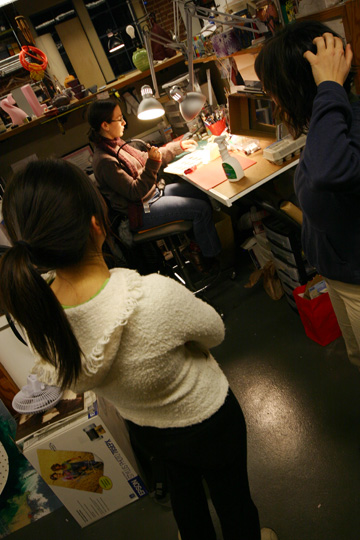
Students are encouraged to visit the campus, tour the Design Loft and Product Realization Lab, meet current graduate students and interview with the faculty during their admissions process. Campus and faculty visits can be arrange by contacting Kristen Taylor at kristenk@stanford.edu.

Stanford is a selective University with high standards for admission to its graduate programs. General information about the University can be found at http://www.stanford.edu/. General information about graduate admissions can be found at http://gradadmissions.stanford.edu/.

The cost of an education at Stanford is always an issue for students. Information about financial aid for undergraduates can be found at http://www.stanford.edu/dept/finaid.

General information about graduate student issues, including financial aid, teaching assistantships, classroom assistantships, and graduate student life can be found at http://www.stanford.edu/dept/DoR/GSH/Sec1.html.

Stanford Design Program - Joint department offerings

Students can apply to either the School of Engineering or the School of Humanities and Sciences and can graduate from the Design Program with one of two degrees; an MS in Engineering - Design from the Mechanical Engineering Department or an MFA - Design from the Department of Art & Art History. The degree program that fits the student best depends on the student’s undergraduate and work experience and their individual ambition. Students who have technical backgrounds (typical a Bachelor of Science degree in engineering, physics, etc.) typically apply to the mechanical Engineering Department. Students who have undergraduate art or design degrees (art, art design, industrial design, graphic design, architecture, etc.) typically apply to the Department of Art & Art History.

The Master of Fine Arts – Design degree:

The requirements for admission to Stanford Design Program for the MFA program are similar to other programs in the Department of Art & Art History. Detailed requirements for applying to the MFA-side of the Design Program can be found at http://art.stanford.edu/graduate.php?content=ms or by contacting Jill Davis in the Art Department at jmdavis@stanford.edu.

The Masters of Science in Engineering - Design degree:

Typically students who are engineering or science graduates from other universities apply to the Mechanical Engineer Department. Detailed requirements for the application are below.

Both the MS and MFA students complete essentially the same sequence of classes: a series of Design Thinking, methodology and strategy courses in their first year of graduate study and a second year dominated by a self-directed Master's Thesis project that can be completed individually or in self-formed small teams.

Requirements for Applications: Masters of Science - Design

Checklist - A completed application to Stanford’s Design Program in the Mechanical Engineering Department consists of:

*Letters of recommendation are not submitted online, transcripts, and design portfolios or case study books must be mailed directly to:

In addition to the normal University requirements, admission to the Stanford Design Program Masters of Science degree program has additional requirements that make your application distinctive:

- we require a minimum of one year's experience in life after your undergraduate work prior to your application to the Stanford Design Program. This can be professional experience, service experience (the Peace Corps, an NGO, etc.), or several years solo sailing the world or mountain climbing in the Himalayas. The typical admitted student has an average of four years of real world experience and we find that this experience and maturity becomes a major resource in the Loft as the students progress through the program. Work-study, internships, and other experience gained during you undergraduate education doe not count toward this requirement.

- we require a Statement of Purpose that describes your motivation for studying in our program. Stanford’s Design program is one of a kind. No other program that we know of combines the elements of art, engineering, psychology, ethnography, and business quite like we do. Because of this, most of our applicants only apply to the Stanford Design Program because they are seeking something special – a real “fit” to their unique personality. If you apply, you are probably one of those people. You have a reason that you’ve decided to come to Stanford to study design in our radical, multidisciplinary program. We want to know what that reason is.

What we do not want in the Statement is a recapitulation of your resume, work, and educational experience. Instead use this opportunity to tell us what you are passionate about and how Stanford can uniquely create a place for you to realize that passion.

- we require a portfolio that demonstrates the candidate's design abilities, design process, leadership abilities, aspirations, problem solving ability, and imaginative capacity.

A physical portfolio is required. We do not require a digital copy. Other than “it is physical” there are no specific guidelines on the kind of portfolio you submit or how many pieces should be in the portfolio. Think of the portfolio as your vehicle to demonstrate who you are and how you think. Given this, each portfolio is expected to be unique. However, please do not provide too large a portfolio, with repetitive examples of the same media, process, or end-product. We are looking for breadth as well as depth and will judge the quality of your presentation and its appropriateness by your editing and selection.

Your portfolio should be about your design process, your design thinking, the types of design and subjects you're interested in. It should demonstrate your ability to visualize things. It should show us how you develop new and innovative solutions. These solutions can be in almost any area but we are particularly interested in new products, services, environments, information, and smart spaces. It should have an example or two of completely finished pieces of artwork/craftwork (2D or 3D) that you are passionate about. It should express your independent thinking on the subjects that you think are important.

NEW!

This year for the first time, we are also accepting an alternative to the portfolio and you might consider submitting a case study book instead. Here’s the difference:

A portfolio is typically a collection of your best pieces of art, design, and engineering, and it is a tried and true way to demonstrate your creativity. However, given the change in focus of our curriculum toward more Design Thinking, strategic innovation, and design leadership, a portfolio may not be the best way to present your unique set of skills. We are adding a new format, the case study, to the admissions process because we want to make sure that design thinkers and developing leaders have the best opportunity to show us why they should be considered for our program. A traditional portfolio might not capture important information about their candidacy. For instance, we think that case studies are a particularly useful way to demonstrate a holistic portrayal of the way you approach thinking and problem solving. Case studies are a great way to explain your creative process and can include all the “messy prototypes” and “important failures” that just don’t fit in the portfolio format. Case studies are also one good way to show us non-design projects that emphasize your leadership skills and your strategic thinking.

A case study is typically a one or two page description of a project. It should include some description of the original problem and lots of visual information about the process that resolve it. We are not looking for a lot of writing. As designers, we prefer case studies that are more like narratives or storyboards, not like research papers, but some writing may be necessary to frame the story for the reviewers.

A case study book will contain a series of these case studies and may also include an overview or explanation of how each individual case is related to a larger theme. Of course, you are going to ask “how many cases” and we are going to answer “its hard to say”. In general six to eight examples, each illustrating different aspects of your work should be plenty. However, you may have completed one or two very large and comprehensive projects that demonstrate a variety of your skills and want to focus on these. In this example two (or even one) case studies might be sufficient. These are likely to be multi-page, multi-topic studies so their organization and clarity become even more important.

There is no preference given in the admission process to either a portfolio or a case study book – either is equally acceptable. Choose the format that you think will be the best way to represent your skills and your potential. We welcome both.

Application deadline: January 13th for admission to the subsequent Fall Quarter
The Portfolio or Case Study book deadline is January 13th (physically in-house)

We highly recommend an on-campus interview with the faculty after submitting your application. Please contact our administrator Kristen Taylor at kristenk@stanford.edu to schedule your interview.

Remember, a completed application to Stanford’s Design Program in the Mechanical Engineering Department consists of:

*Letters of recommendation are not submitted online, transcripts, and design portfolios or case study books must be mailed directly to:

Note

Occasionally, students wishing to earn the M.S. degree who have other academic preparation (Architecture, Industrial Design, Psychology, etc.) can be admitted to the MS program, with some qualification. Typically these students will need to complete enough engineering classes prior to attending Stanford to qualify for an engineering degree. At a minimum, these classes include:

Admission to the MS program without a Bachelor of Science degree is by exception only and students who wish to apply in this manner must have an interview with the Executive Director to determine their eligibility. Interviews can be arranged by contacting design program administrator Kristen Taylor at kristenk@stanford.edu.

To obtain a printable version of this page, please download Stanford Design Program Graduate Admissions (PDF, 150K).