
Communications: xBee Radio | ||
|
Home
The Game Water Craft Helm Communications Protocol xBee Pairing Gems of Wisdom Media |
The xBee radio is a device that wirelessly communicates data sent to it by a
microcontroller. When transmitting, the xBee sends out the data packet
asynchronously transmitted to it by the microcontroller. When receiving, the
xBee only forwards transmissions that are addressed to it (or broadcast for
everyone) to the microcontroller. Use of the xBee is fairly similar to
reading/writing to a port. So long as the byte order outlined below is followed,
data will transmit from one xBee to another. Receiver ·
12
bytes are shifted in from xBee DO UART port - some
are useful ·
Byte
order 0.
Start
Delimiter (always 0x7E) 1.
Length
– MSB (should be 0) 2.
Length
– LSB (should be 8) 3.
API
identifier (0x81 for received transmission) 4.
Source
address – MSB § xBee address of sender – unique to
each craft/helm/admiral § 0xBC for helm or admiral
addressing helm § 0xAF for craft or admiral
addressing craft 5.
Source address – LSB § Specific # of craft/helm (0x01
through 0x0C) § FF for Admiral 6.
Signal
strength indicator 7.
Options
§ Bit 1 high for direct address
(only sent to this radio) § Bit 2 high for PAN broadcast
(sent to all radios) 8.
ME218
byte 0 9.
ME218
byte 1 10. ME218 byte 2 11. Checksum § Σdataframe + checksum = 0xFF Transmitter ·
Write
to xBee DI port (UART) ·
Byte
order 0.
Start
Delimiter (always 0x7E) 1.
Length
– MSB (should be 0) 2.
Length
– LSB (should be 8) 3.
API
identifier (0x01 for transmit request) 4.
Frame
ID § Number indicating this
particular message § Set to 0x00 to disable message
sent response 5.
Destination
Address – MSB (0xFFFF for broadcast) § xBee address of receiver – unique
to each craft/helm/admiral § 0xBC for helm § 0xAF for craft 6.
Destination
Address – LSB § Specific # of craft/helm (0x01
through 0x0C) § FF for Admiral 7.
Options § Set to 0x00 to enable ACK 8.
ME218
Byte 0 9.
ME218
Byte 1 10. ME218 Byte 2 11. Checksum § checksum = 0xFF – Σdataframe Checksum: Not including frame delimiters and length, add up all bytes keeping only the lowest 8 bits of the result and subtract from 0xFF. The validity of incoming packets was determined by checking the first four bytes of the packet. If the first four bytes matched their expected values, then the packet was determined "valid" and processed. A state machine outlining this process may be found by clicking the thumbnail below: 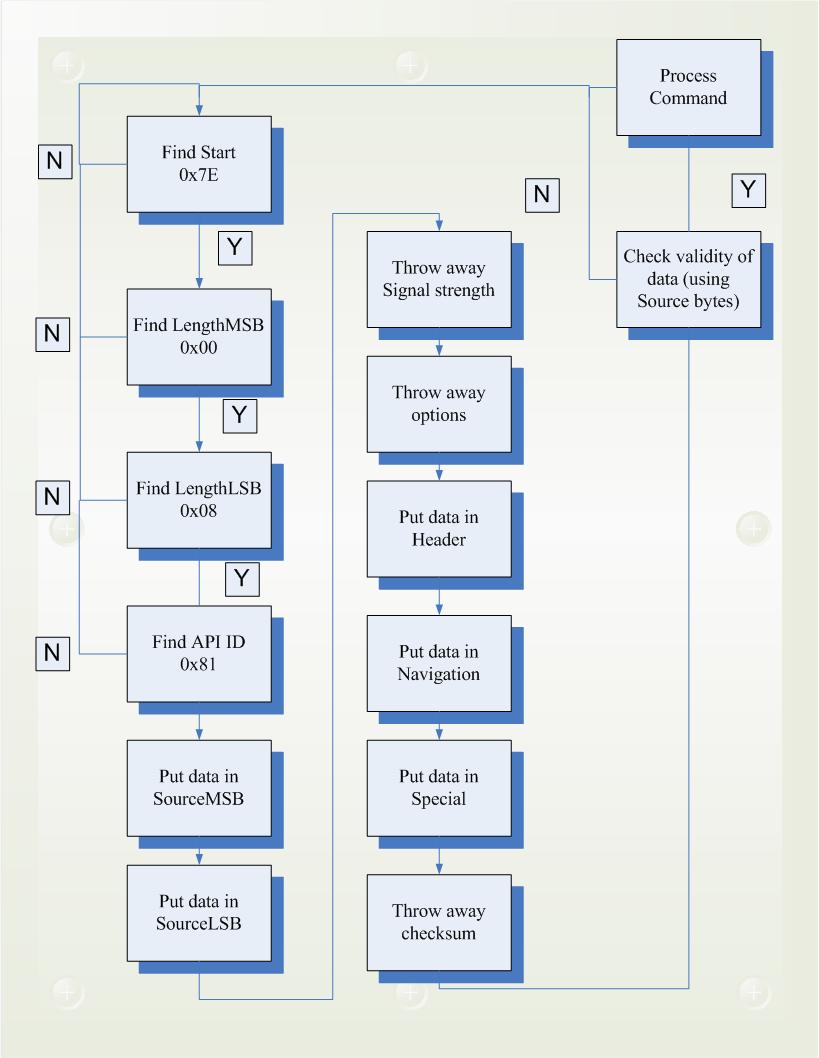 |
|