




Jump To: Helm Mechanical
Description
Watercraft Mechanical
Description
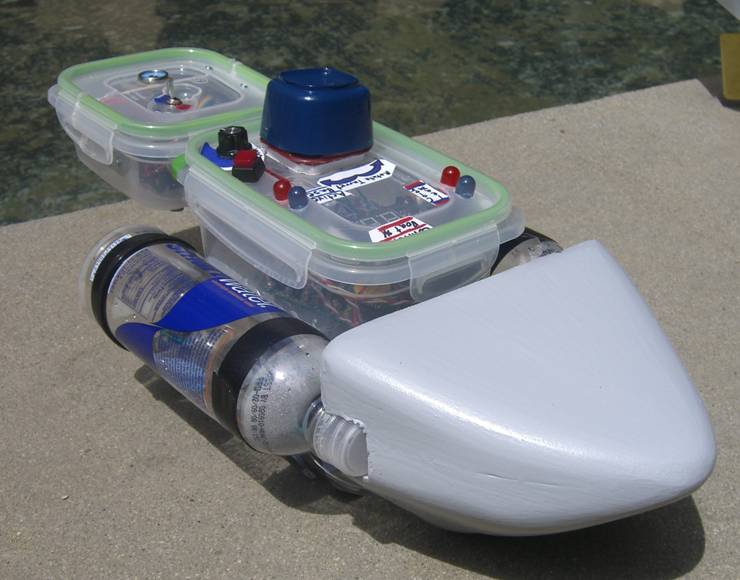
For the helm, we chose to create
a model of the craft, with inputs that allow the user’s manipulation of the
helm to control the craft. The user can
tilt the helm forward and back and side to side, and the motion of the boat
will reflect the motion of the helm. In
addition to motion control, the user can turn the model turret on the helm and
have the turret on the boat reflect that motion.
This control input creates
an interesting, engaging, and intuitive experience for the users, as well as
entertainment for bystanders watching the user move themselves along with the
controller.
The controller uses two PIC
16F690 microcontrollers, one to handle communication and the state machine, and
another to take the control inputs and convert them into movement and special
action bytes as specified by the communications protocol.
Watercraft Mechanical Description
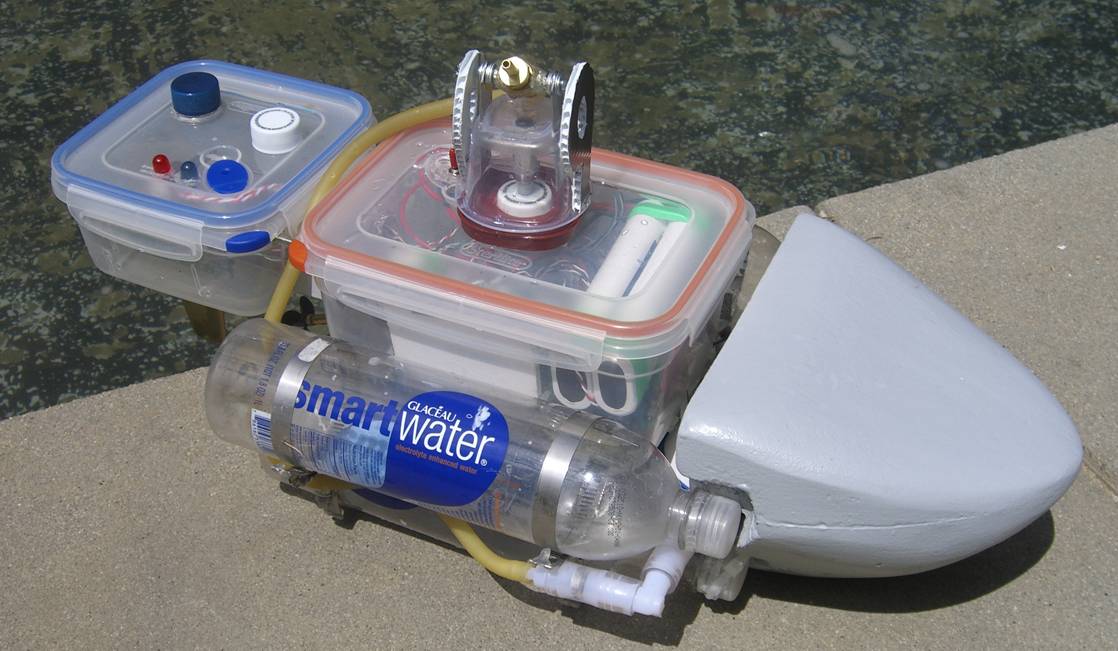
The concept for the boat is
a stable platform that can deliver water accurately from long range. The main part of the craft is a pair of
tupperware containers: the front one for the motors, batteries, control
circuitry, and power circuits, the rear for the rudder, servo, and
communication board. For floatation, the
boat mounts four large water bottles, which can be filled with water to adjust
the trim. On the front, there is a
shaped bow with a cutout for the mounting of the bilge pump that allows the
water to flow better around the hull.
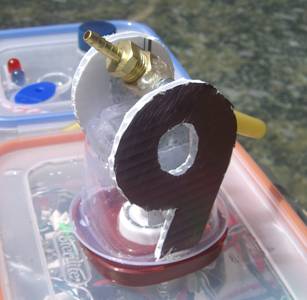
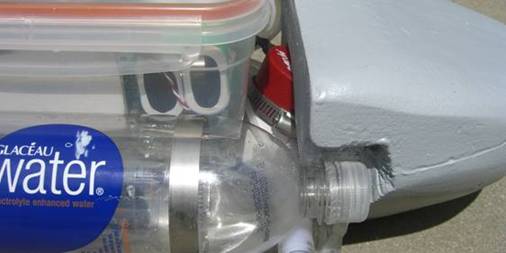 The bilge pump output runs through surgical tubing
around the hull to the turret on top of the boat, which is mounted on a stepper
motor and can rotate either direction.
Between the rotation and an ability to use PWM to control the water
stream, the boat can deliver water to almost anywhere within 5-6 feet.
The bilge pump output runs through surgical tubing
around the hull to the turret on top of the boat, which is mounted on a stepper
motor and can rotate either direction.
Between the rotation and an ability to use PWM to control the water
stream, the boat can deliver water to almost anywhere within 5-6 feet.
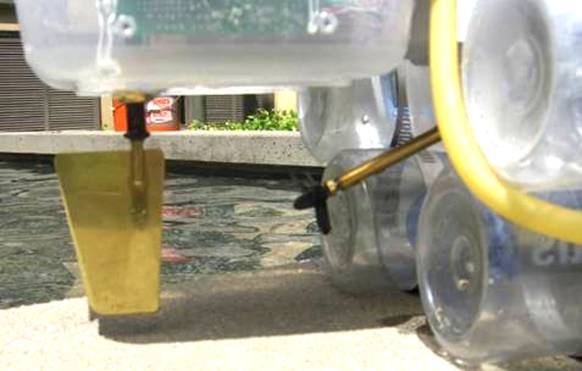
The craft navigates using
the combination of a single propeller attached to a maxon ungeared motor and a
large rudder attached to a servo. The
rudder is mounted directly behind the propeller to maximize its effect and
decrease the turning radius of the boat.
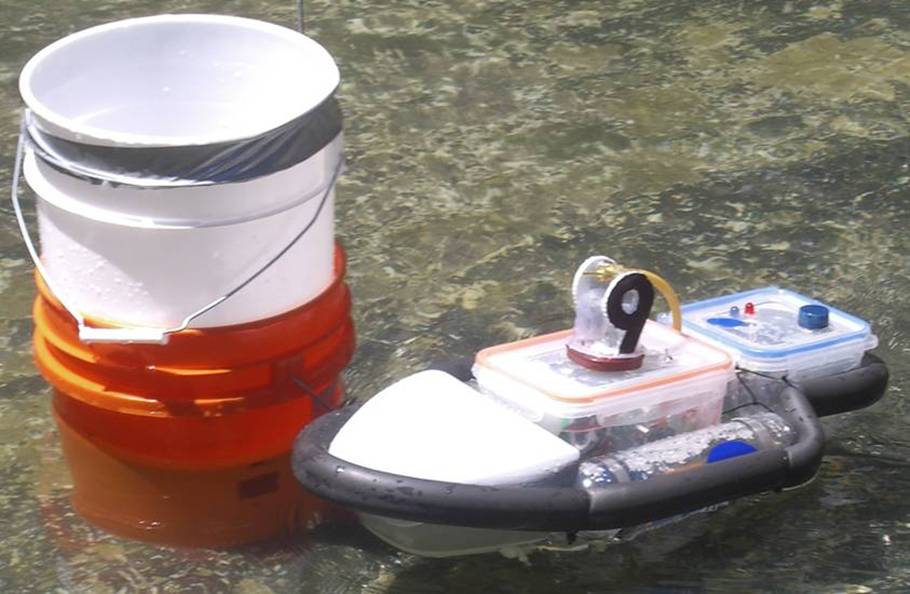
Finally, the boat mounts the
class standard rubber bumper to ease the effects of collisions with other craft
and obstacles.