Introduction—ME218B Winter
2008
The Project
The project for ME218B involved collecting Nerf balls from
a central dispenser and then placing them into one of three different goal
areas, for a varying number of points.
The full project description can be found here.
The Strategy
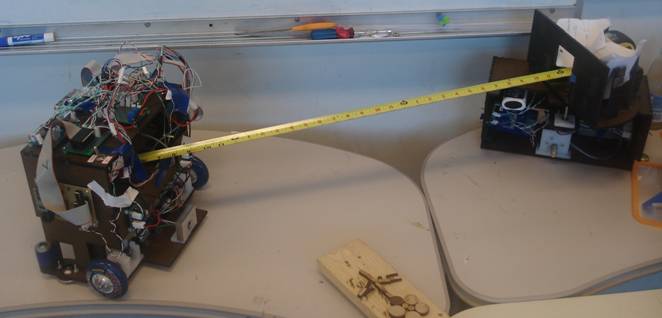
Our strategy revolved around a robot which would drive to
the beacon dispenser, orient itself, and then release a latch between two
halves of the bot. The front half of the robot, containing most of the
sensors and the drive train, would drive towards Goal Three, pulling with it
a tape measure to act as a bridge between the two halves of the bot. The back
half (“backbot”) would remain at the beacon dispenser, continually requesting
balls and funneling them onto the bridge between the two halves. The balls
would travel down the bridge and fall into Goal Three, where the geometry of
the front half would aid in stacking the balls.
Perceived Advantages
The primary advantage of this robot design was the very
high scoring potential. Due to the relatively small size of Goal Three, we
felt that, with the aid of the front back extending the box, we could stack
significantly more balls in that goal than a robot without a stacking aid. As
Goal Three provides the largest number of points, being able to deliver more
balls into Goal 3 than any other team should be a tremendous advantage.
Other advantages include:
-
the sheer novelty of the design. We tackled
issues no other team had to face.
-
Less sensing required than a team which
ferries balls from the dispenser to the goal
-
Simplicity of control scheme. While this never
really bore out due to time constraints, our robot’s behavior could be
written almost purely sequentially.
Perceived Disadvantages and Challenges
The main disadvantage to this design concept (that we
thought of at first) was the shear difficulty of it. We faced significant
mechanical challenges in latching the robot halves, allowing them to unlatch
cleanly, causing the backbot to stay in place effectively, allowing the
bridge to swivel appropriately, pulling the tape with the front half, and
doing all of the above within the space constraints given.
Performance
The performance of 50 lbs of Robot Love bore out the
potential of our strategy as well as the effects of having a very difficult
design.
In testing, we were eventually able to successfully score
the maximum number of points (96) by funneling all 20 balls into Goal Three.
We successfully found the ball dispenser, delatched the two halves of the
bot, found Goal 3, placed the stacking aid, and begin the reception of the
balls.
However, in competition, we suffered due to lack of robust
code and a further testing period. Our
tape sensor picked up a false positive while finding the right angle bend in
the black tape strip, and began its beacon-approach-and-detach routine much
too early. If we had had more time to calibrate our tape sensors, or to write
code that could validate a tape sensor hit through other means, we believe
that we could’ve had a lot of success.
Lessons Learned
Along the way, we also ran into several unforeseen
issues. The most severe issue we
encountered was most surely weight. To counter the rather large moments placed
on the bot by pulling the FatMax bridge, we had to place upwards of 20 pounds
of counterweights over the casters of frontbot and at the back of backbot.
The increased weight limited our speed, and the distribution thereof also
limited the force we placed on our wheels, limiting our available driving
force. In addition, the added weight made latching and de-latching much
harder, as we were more prone to binding.
We initially used set screws in our motor mounts and in our shaft
couplers and we learned two facts about using set screws. First, flat head set screws should be
avoided—it is very difficult or impossible to put a lot of torque onto a flat
head set screw without breaking the screw, which means the screw may frequently
work itself loose. Second, set screws
on especially hard shafts are not as effective—it is just as easy to use a
pin, but the pin will hold while the set screw may slip.
|